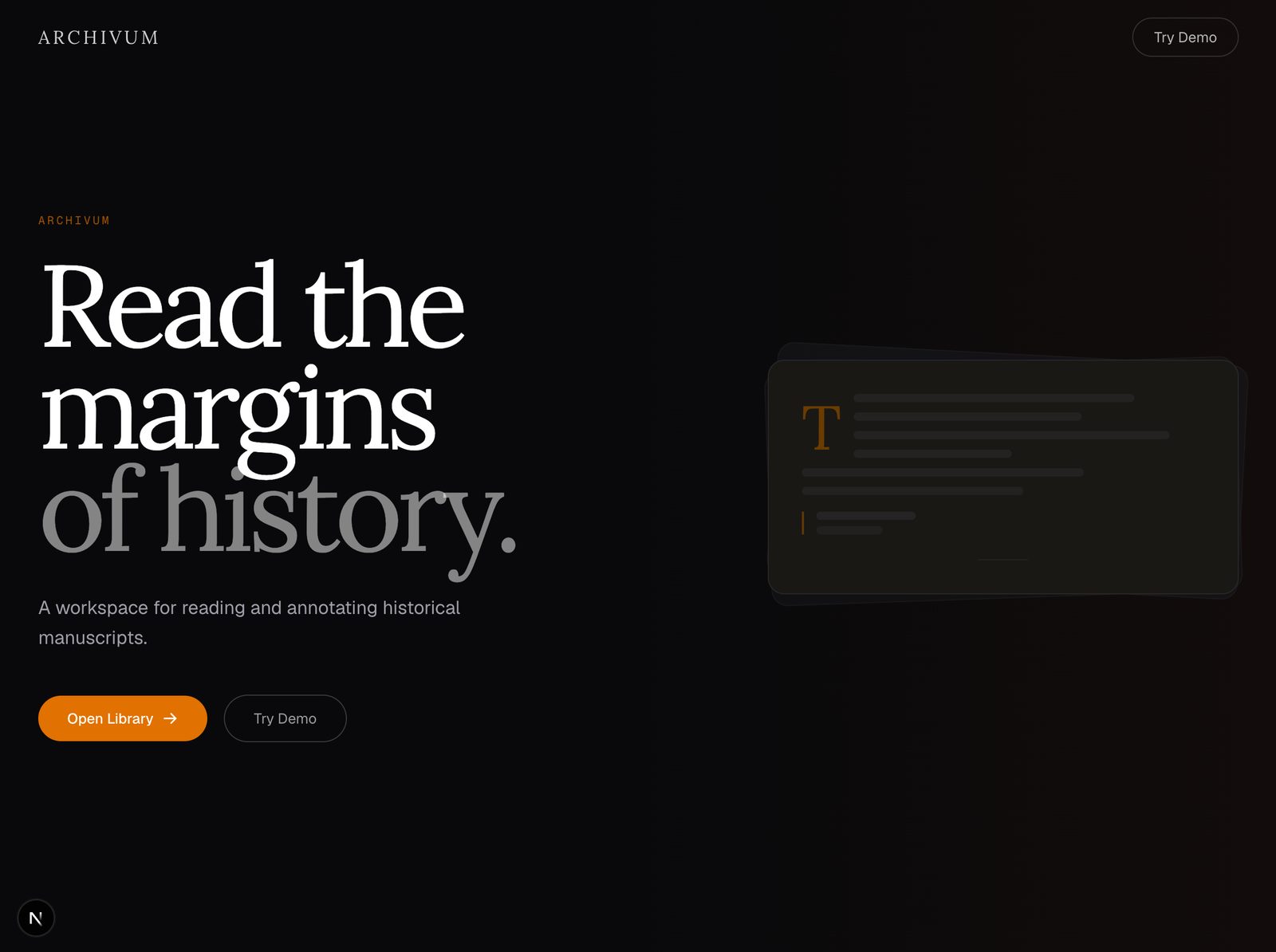
Archivum
Commissioned by an Oxford University student as part of her dissertation research, a workspace for reading and annotating old scanned documents that don't work with regular PDF tools.
- Next.js
- React
- TypeScript
- Tailwind CSS
- pdf.js
- MongoDB
Overview
Archivum was commissioned by an Oxford University student to build something to help them complete their dissertation: reading and annotating long historical manuscripts, page after page of dense early modern poetry, scanned at high resolution.
It also serves a broader purpose: a way to annotate old scanned documents that don’t work with regular PDF annotation tools.
The Problem
Scanned manuscripts are images, not text. Standard PDF viewers can’t search them, and their annotation tools assume digital documents: highlights that snap to invisible text layers, notes that float in a void, tools that fall apart on a 1618 scan with decorative borders and irregular margins.
A dissertation built on these documents needs something else: the ability to mark a page, write a note bound to that exact page, structure a table of contents across the whole manuscript, and pull everything together at the end.
The Solution
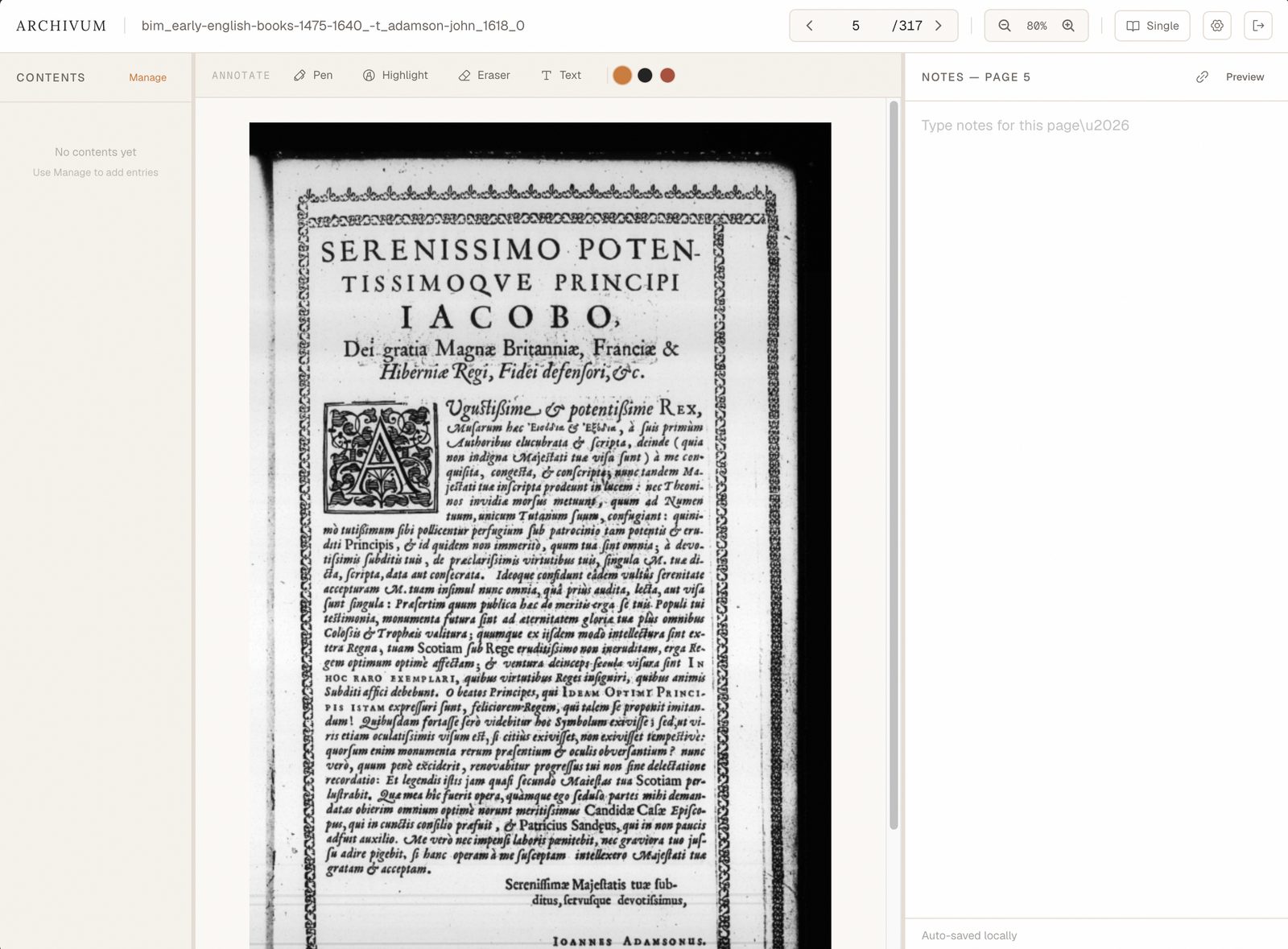
Archivum is a purpose-built manuscript reader with a warm, archival aesthetic and a three-panel workspace that treats scans as the primary document:
- Resizable panels: contents on the left, the manuscript page in the centre, notes on the right
- Page-bound notes: a rich editor attached to each physical page, with compiled-notes view that merges them into one chronological document for export
- Vector annotation layer: freehand pen for marginalia and underlining, horizontal highlighter, and a vector eraser that removes individual strokes without touching the page
- Manual TOC builder: poems and sections mapped to their pages, cross-linked across documents
- Hybrid storage: PDFs live in the browser (IndexedDB) for instant, zero-latency loading; notes, annotations, and structure sync to the cloud; full offline backup as a single bundle
Design & Engineering
- Next.js app router with
pdf.jsrendering and a canvas-based vector annotation engine - Local-first architecture: Dexie.js/IndexedDB for PDF blobs, MongoDB sync for notes and structure
- Password-protected access, resizable panel layout, and a warm alabaster design system with amber accents: a modern tool that respects the material it’s reading
Outcome
A dissertation-completion tool built for one person and useful to anyone working with scans: historians, archivists, and students annotating documents that regular PDF tools can’t handle.
Live at archivum.jonathansimpson.co.
Outcome: Delivered a scholarly reading workspace that turns scans of 17th-century manuscripts into a research tool: local-first PDF rendering, page-bound notes, vector annotations, and a compiled export pipeline built for dissertation writing.